

Porsche story begins with Ferdinand Porsche, an engineering genius born in 1875 in what is now the Czech Republic. Before founding his own company, Ferdinand had already established himself as one of Europe’s most brilliant automotive minds.
His early innovations were groundbreaking, he created the world’s first functional hybrid vehicle, the Lohner-Porsche Mixte Hybrid, in 1901. This revolutionary car combined an internal combustion engine with electric wheel-hub motors, a technology that would take the automotive world over a century to fully embrace.
During his tenure at Daimler-Benz in the 1920s, Porsche designed the legendary Mercedes-Benz SS/SSK sports cars before establishing his own consulting firm in 1931. The company’s first major assignment was designing a “people’s car” for the German government, which would eventually become the Volkswagen Beetle, one of the most successful car designs in history.
World War II proved challenging for Porsche, with Ferdinand spending 20 months in prison after the war without trial. During this time, his son Ferry Porsche decided to build his own sports car, declaring he couldn’t find an existing car he wanted to buy. This decision would lead to the creation of the first Porsche-badged vehicle.

The First Porsche: 356 (1948-1965)
The Porsche 356 debuted in 1948 and became the foundation of the Porsche legacy. Built in a small sawmill in Gmünd, Austria, the first 52 cars were hand-built aluminum masterpieces. The 356 featured a rear-mounted, air-cooled four-cylinder engine derived from Volkswagen components but extensively modified for better performance.
What set the 356 apart was its perfect balance of performance and practicality. Though initially producing just 35 horsepower, the lightweight coupe could reach 83 mph, impressive for its time. The design evolved through four generations (Pre-A, A, B, and C), with Porsche continuously refining the engine, brakes, and styling.
The 356 introduced several body styles that would become Porsche traditions:
- Coupe: The original fixed-roof design
- Cabriolet: A more luxurious convertible
- Speedster: A stripped-down, lower-cost open-top version that became highly sought-after by collectors
By the time production ended in 1965, Porsche had built 77,361356 models, establishing the company as a serious sports car manufacturer and setting the stage for its legendary successor.
The Iconic 911 (1964-Present)
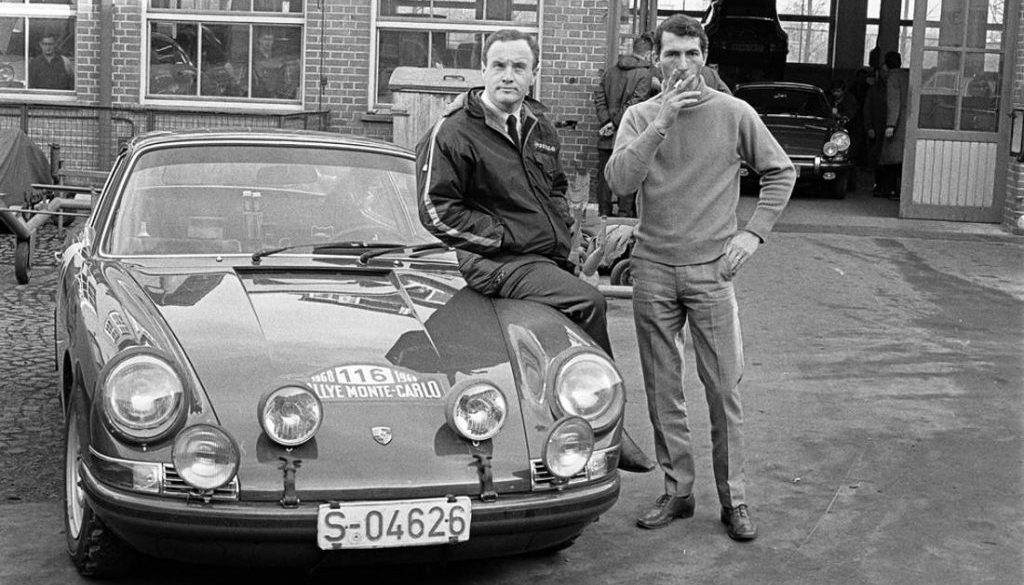
Introduced in 1964 as the successor to the 356, the Porsche 911 would become one of the most iconic sports cars in history. Designed by Ferry Porsche’s son, Ferdinand Alexander “Butzi” Porsche, the 911 maintained the rear-engine layout but featured a more powerful six-cylinder “boxer” engine.
The 911’s design was initially controversial but would become timeless. Interestingly, the car was initially designated the 901, but had to be renamed due to Peugeot’s trademark on three-digit numbers with a zero in the middle.
Porsche 911 Generations
| Generation | Years | Key Features |
|---|---|---|
| Original | 1964-1989 | Air-cooled engines, progressive refinements |
| 930 | 1975-1989 | First turbocharged model |
| 964 | 1989-1994 | First all-wheel drive 911, significant modernization |
| 993 | 1995-1998 | Last air-cooled 911, highly collectible |
| 996 | 1999-2004 | First water-cooled engine, controversial headlights |
| 997 | 2004-2012 | Return to classic 911 styling cues |
| 991 | 2012-2019 | Longer wheelbase, advanced technology |
| 992 | 2019-present | Current generation, hybrid technology |
The 911 Turbo (930), introduced in 1975, earned the nickname “Widowmaker” for its challenging handling characteristics but set new standards for performance cars. Throughout its evolution, the 911 has miraculously balanced continuous innovation with respect for its iconic design and driving characteristics.

Expanding the Porsche Lineup
While the 911 remained the heart of the brand, Porsche expanded its model range to include more accessible and practical vehicles:
Front-Engine Models (1970s-1990s)
- Porsche 914 (1969-1976): A mid-engined entry-level model developed with Volkswagen
- Porsche 924 (1976-1988): The first Porsche with water-cooled front engine
- Porsche 928 (1978-1995): A grand tourer with V8 power, intended to replace the 911
- Porsche 944 (1981-1991): Successor to the 924 with Porsche-designed engine
Boxster and Cayman (1996-Present)
The Porsche Boxster roadster (1996) and Cayman coupe (2005) provided mid-engine handling at more accessible prices. These models were crucial for Porsche’s survival in the 1990s, sharing development costs and components while introducing a new generation to the brand.
Porsche Racing Achievements
Porsche’s competition success began almost immediately with the lightweight 550 Spyder in the 1950s. The company has since accumulated over 24,000 race wins worldwide, including more than 50 class victories at the 24 Hours of Le Mans.
Legendary racing models include:
- 917 (1969-1971): Gave Porsche its first overall win at Le Mans in 1970
- 936 (1970s-1980s): Three-time Le Mans winner
- 956/962 (1980s): Dominated Group C racing with multiple Le Mans wins
- 919 Hybrid (2014-2017): Three consecutive Le Mans wins using hybrid technology
Porsche’s racing philosophy has always been “win on Sunday, sell on Monday”, using competition to develop technology that eventually trickles down to production cars.
Modern Era and SUV Revolution
Porsche faced significant challenges in the early 1990s but underwent a remarkable transformation under Wendelin Wiedeking’s leadership, who implemented lean manufacturing principles learned from Toyota.
The controversial but tremendously successful Porsche Cayenne (2002) SUV saved the company financially. Despite purist concerns, the Cayenne maintained Porsche’s performance standards while providing the practicality buyers wanted. This was followed by the smaller Macan (2014), which became Porsche’s best-selling model.
The Panamera (2009) four-door grand tourer further expanded Porsche’s market reach, proving that the brand could expand beyond two-door sports cars without diluting its identity.
The Future of Porsche
Porsche embraced electrification with the Mission E concept (2015), which evolved into the Taycan (2019), Porsche’s first all-electric production car. The Taycan maintains Porsche’s performance standards with astonishing acceleration and handling, proving that electric vehicles can be true Porsches.
The company continues to develop a mix of gasoline, hybrid, and electric vehicles, with plans to make 80% of its sales electric by 2030.
Frequently Asked Questions
What was the first Porsche ever made?
The first Porsche-badged car was the 356 introduced in 1948. However, Ferdinand Porsche had designed many vehicles before including the Volkswagen Beetle and the Lohner-Porsche hybrid.
Why is it called 911 when the first model was 901?
Porsche initially named the car 901, but Peugeot claimed rights to three-digit numbers with a zero in the middle. Porsche simply changed the zero to a one, creating the now-famous 911 nameplate.
What does “Carrera” mean in Porsche models?
Carrera is Spanish for “race” or “career.” The name was first used for Porsche’s class-winning 356 model in the Carrera Panamericana race in Mexico. It now denotes higher-performance versions of Porsche models.
How did Porsche survive the difficult 1990s?
Porsche survived through the introduction of the Boxster, implementation of lean manufacturing techniques learned from Toyota, and later the successful launch of the Cayenne SUV.
Does Porsche still use air-cooled engines?
No, the last air-cooled 911 (the 993 generation) was produced in 1998. All current Porsches use water-cooled engines.
Who owns Porsche today?
Porsche is part of the Volkswagen Group. In a complex arrangement, Porsche Automobil Holding SE owns a majority stake in Volkswagen AG, which in turn owns Porsche AG.
What was Porsche’s involvement with World War II?
During WWII, Ferdinand Porsche’s company designed military vehicles including tanks. After the war, Ferdinand was imprisoned for 20 months but never tried. The company’s postwar efforts focused on civilian vehicles.
 Car Community
Leave a comment