


When Porsche introduced the 550 Spyder in 1953, the automotive world scarcely noticed. Yet this modest-looking, aluminum-bodied roadster would soon redefine what a small manufacturer could achieve against established racing giants.
With its revolutionary mid-engine design and screaming four-cam motor, the 550 Spyder didn’t just compete, it dominated, humbling cars with twice its power and displacement. This lightweight marvel became the foundation upon which Porsche built its motorsport legacy, creating a template for performance that would influence generations of sports cars to come.
Porsche 550 Spyder Design
The 550 Spyder emerged from Porsche’s urgent need to establish credibility in international motorsport. Though the 356 had shown promise, Ferry Porsche recognized that only a purpose-built racing car could truly showcase the company’s engineering capabilities. The project began under the guidance of motorsport director Huschke von Hanstein, drawing inspiration from earlier Porsche-engined specials but incorporating fully factory-developed solutions.
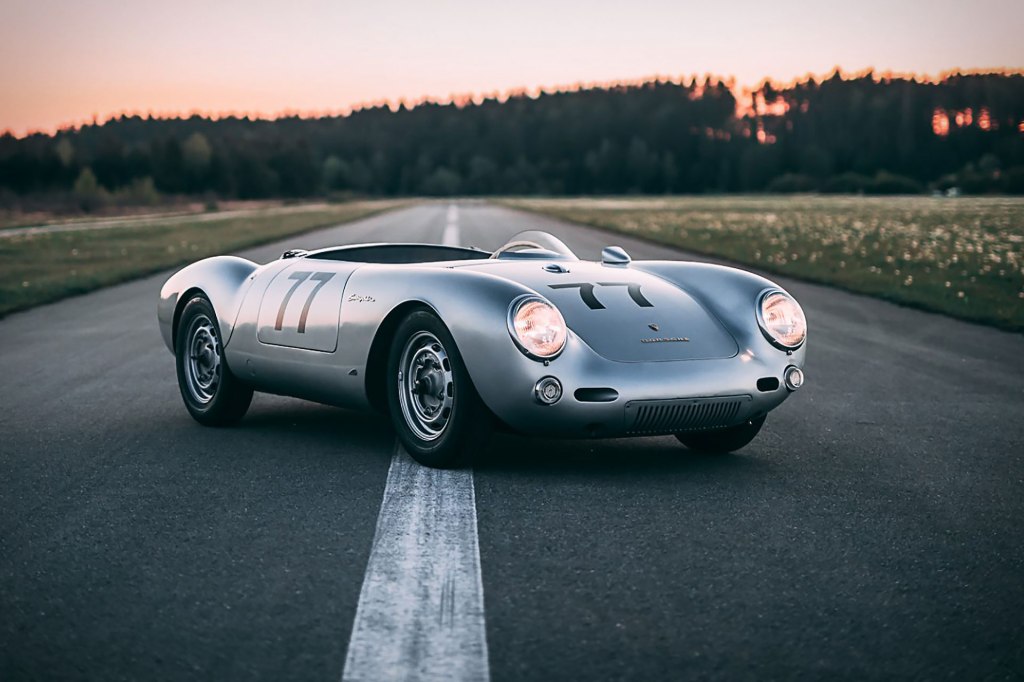
What set the 550 apart was its spaceframe chassis and mid-engine layout, a configuration then uncommon in production-based racing cars. The chassis featured a lightweight tubular framework that provided exceptional rigidity while keeping weight to an absolute minimum. The body, designed by Erwin Komenda, was formed from aluminum panels that contributed to the car’s remarkably low total weight of just 1,212 pounds.
The heart of the 550 Spyder was its technically advanced Type 547 engine. Designed by Ernst Fuhrmann, this 1.5-liter air-cooled flat-four featured dual overhead camshafts per cylinder bank, four camshafts in total, and a complex system of bevel gears driving the camshafts. This sophisticated design allowed the engine to rev to 7,200 RPM while producing between 110 and 135 horsepower, depending on specification.
Porsche 550 Racing Dominance
The 550 Spyder’s competition debut at the 1953 Nürburgring Eifelrennen resulted in an immediate victory, beginning one of the most successful racing careers for any sports car of the period. Throughout the mid-1950s, the 550 Spyder achieved remarkable success in endurance events worldwide, including class wins at Le Mans from 1953 through 1958 and an overall victory at the 1956 Targa Florio.
Privateer drivers particularly appreciated the 550 for its reliability and relatively straightforward maintenance. The car competed in over 370 races between 1953 and 1965, securing 95 overall wins and 75 class victories. This competition success established Porsche as a serious manufacturer of sports racing cars and provided valuable technical information that would influence future models.
The updated 550A variant introduced in 1956 featured a lighter and stiffer spaceframe chassis that improved handling characteristics significantly. This version achieved perhaps its greatest victory when it delivered Porsche’s first overall win in a major international event at the 1956 Targa Florio.
Porsche 550 Performance
The 550 Spyder’s technical specifications were impressive for their time. The 1.5-liter engine utilized dry-sump lubrication, crucial for maintaining oil pressure during high-speed cornering. Power was transmitted through a five-speed manual transmission, advanced for an era when four-speed gearboxes were still common.
The suspension system consisted of independent suspension at all four corners, with torsion bars and telescopic shock absorbers. The braking system utilized drum brakes all around, adequate for the car’s lightweight construction. The car’s minimal weight and aerodynamic bodywork allowed for a top speed of approximately 140 mph, with acceleration from 0-60 mph in about 8.2 seconds.
The cockpit reflected the car’s racing purpose, featuring a simple dashboard with essential instruments, a wood-rimmed steering wheel, and lightweight bucket seats. Weather protection was minimal, with a small windscreen and optional side curtains rather than proper windows.
Porsche 550 Spyder Impact
Beyond its racing success, the 550 Spyder gained cultural significance through its association with American actor James Dean. Dean purchased a 550 Spyder in September 1955, nicknaming it “Little Bastard.” Tragically, he was killed in a collision while driving the car to a race in Salinas, California, on September 30, 1955. This event created lasting mythology around the car and its alleged curse, though it also brought international attention to Porsche’s racing efforts.
The 550 Spyder’s design influence can be seen in subsequent Porsche models, particularly the 718 RSK that followed it. The mid-engine layout pioneered in the 550 would eventually become standard for racing Porsches through the 906, 908, and 917 models, and ultimately influence the design of road cars like the Boxster and Cayman.

Porsche 550 Spyder Price
Today, the Porsche 550 Spyder ranks among the most desirable collector cars of the postwar era. With only 90 original examples produced between 1953 and 1956, authentic models command prices between $4 million and $6 million at auction, with well-documented examples achieving even higher values.
The car’s historical significance, racing pedigree, and technical innovation contribute to its enduring appeal. Preservation and restoration of these vehicles require specialized knowledge due to the complex nature of the Fuhrmann engine and the scarcity of original components. Many owners participate in vintage racing events and historic rallies, maintaining the 550 Spyder’s tradition of active competition.
Frequently Asked Questions
What distinguishes the 550 Spyder from other Porsche models of its era?
The 550 Spyder was Porsche’s first purpose-built racing car, featuring a mid-engine layout and sophisticated four-cam engine that set it apart from production-based models.
How many 550 Spyders were produced?
Porsche manufactured exactly 90 units of the 550 Spyder between 1953 and 1956.
What was the significance of the 550A model?
The 550A introduced a lighter and stiffer spaceframe chassis that significantly improved handling and contributed to the model’s racing success.
Why is the engine design so notable?
The Type 547 “Fuhrmann” engine featured an advanced design with four camshafts driven by bevel gears, allowing high-revving performance unusual for the period.
What safety equipment was featured in the 550 Spyder?
The car featured basic safety equipment for its era, including a fuel cut-off switch and racing harnesses, though it lacked modern safety features like rollover protection.
How does the 550 Spyder compare to contemporary racing cars?
Despite its small displacement, the 550 Spyder frequently outperformed larger-engined competitors through superior handling, reliability, and aerodynamic efficiency.
What maintenance challenges do owners face today?
Maintaining an original 550 Spyder requires specialized knowledge of the complex engine design and ability to source or fabricate rare components no longer available through conventional channels.
 Car Community
Leave a comment