
During the late 1950s, as automotive manufacturers increasingly turned to larger engines and greater horsepower to achieve racing success, Porsche pursued a different philosophy.
The Stuttgart-based company demonstrated that precision engineering, lightweight construction, and aerodynamic efficiency could overcome significant power disadvantages
718 RSK emerged as the ultimate expression of this approach, becoming one of the most successful and influential racing cars of its era while establishing patterns that would define Porsche’s racing philosophy for decades.
Porsche 718 RSK Design
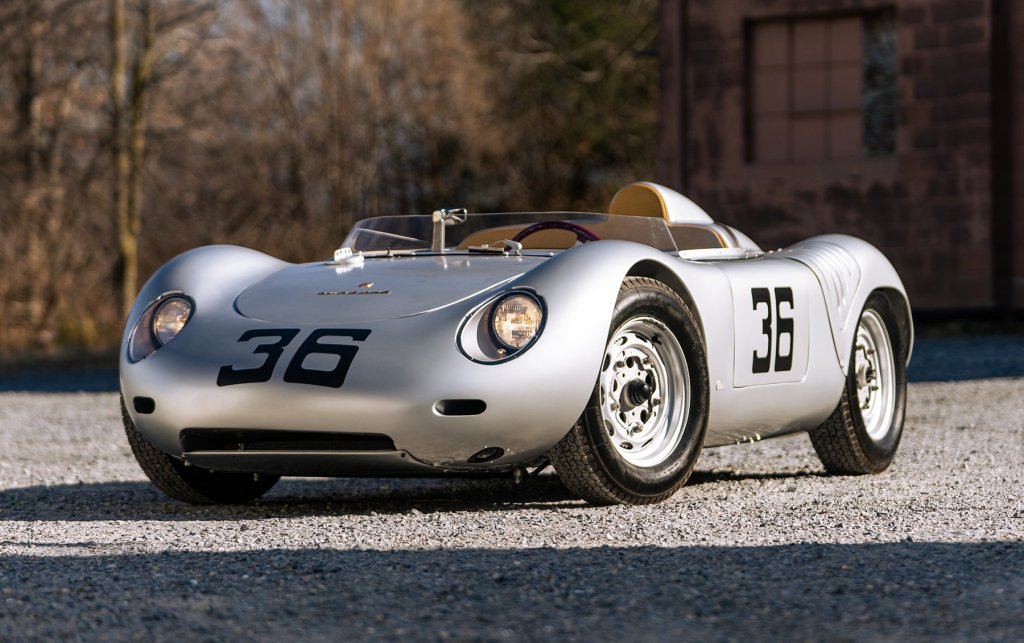
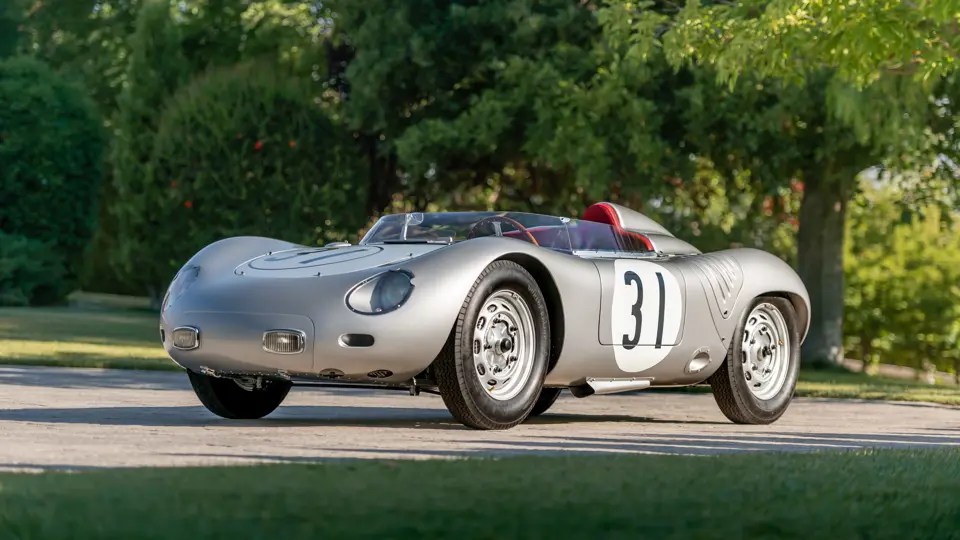
The 718 RSK, introduced in 1957, represented an evolution of the successful 550 Spyder design. Engineers focused on improving aerodynamics, reducing weight, and enhancing handling characteristics. The chassis utilized a spaceframe construction fabricated from seamless steel tubing, providing exceptional rigidity while maintaining minimal weight. The bodywork, crafted from aluminum, featured a more streamlined shape than its predecessor, with covered headlights and improved airflow management.
The suspension system represented a significant advancement over previous designs. The front suspension employed a torsion bar system with a distinctive layout that initially earned the “K” designation in the model name, though this was later simplified. The rear suspension incorporated a Watt’s linkage system that replaced the previous swing-axle arrangement, providing more predictable handling characteristics, particularly during hard cornering.
Power came from the sophisticated Type 547/3 engine, a 1.5-liter air-cooled flat-four designed by Ernst Fuhrmann. This complex powerplant featured four overhead camshafts driven by bevel gears, along with dual ignition systems. The engine produced 142 horsepower at 7,500 RPM, remarkable output for its displacement. This was coupled with a five-speed manual transmission that provided drivers with optimal gear selection for various racing conditions.
718 RSK Racing Success
The 718 RSK achieved immediate success across various forms of motorsport. In endurance racing, the car secured a remarkable third overall finish at the 1958 24 Hours of Le Mans, driven by Jean Behra and Hans Herrmann. This marked Porsche’s first overall podium finish at the legendary French endurance event and demonstrated the car’s remarkable reliability.
The model proved particularly dominant in hill climb competitions, winning the European Hill Climb Championship in both 1958 and 1959. The car’s lightweight construction and precise handling made it ideally suited to the twisting mountain courses that characterized these events. Drivers appreciated the immediate throttle response and balanced chassis that allowed them to maintain momentum through challenging sections.
Perhaps the car’s most impressive victory came at the 1959 Targa Florio, where Edgar Barth and Wolfgang Seidel guided their 718 RSK to overall victory in the challenging Sicilian road race. This success demonstrated the car’s versatility and ability to compete against more powerful machinery from established manufacturers.
The 718 RSK also proved adaptable to single-seater competition. With minimal modifications, including a centralized driving position and revised bodywork, the car competed successfully in Formula 2 events. Jean Behra claimed victory at the 1958 Reims Grand Prix, defeating purpose-built single-seaters from more established manufacturers.
Porsche 718 RSK Specs
The 718 RSK’s specifications were impressive for a production-based racing car of the late 1950s. The vehicle weighed approximately 530 kilograms (1,168 pounds), achieved through extensive use of aluminum and careful attention to weight distribution. The mid-engine layout provided optimal balance, with approximately 44% of the weight on the front axle and 56% on the rear.
The braking system utilized drum brakes on all four wheels, adequate for the car’s lightweight construction though requiring careful management during extended competition. The steering system provided excellent feedback, allowing drivers to precisely place the car through corners.
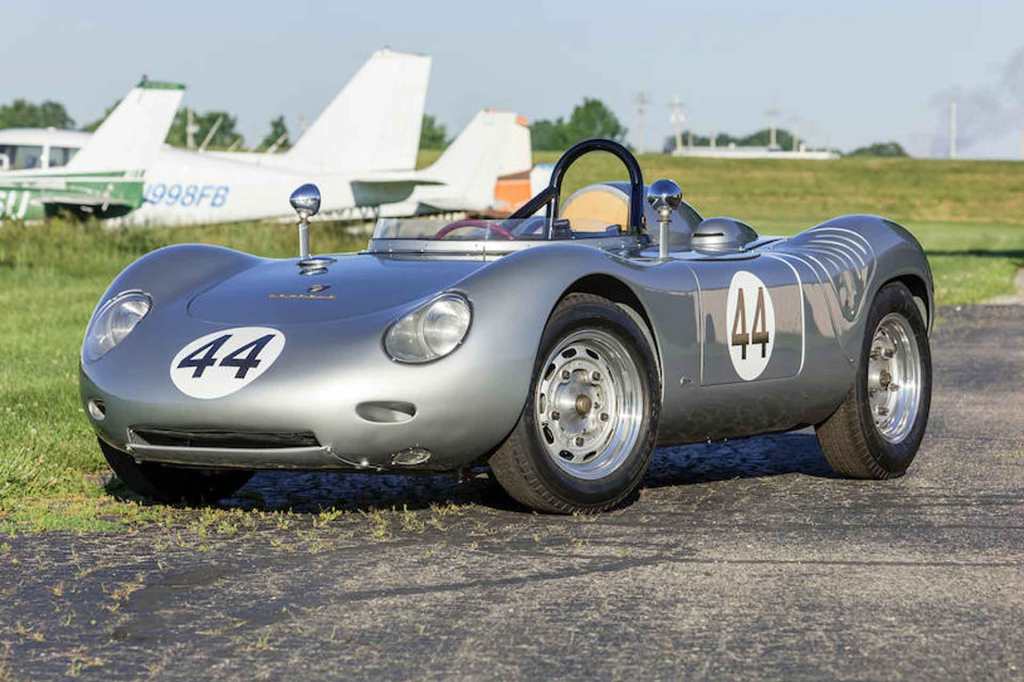
The aerodynamic design incorporated a rounded nose section, covered headlights, and streamlined bodywork that tapered toward the rear. Some competition versions featured additional aerodynamic aids, including a small dorsal fin behind the driver’s headrest to improve high-speed stability.
Porsche 718 RSK Evolution
Throughout its production run, the 718 RSK underwent continuous development. Engineers experimented with various engine configurations, including units with larger displacement and revised cylinder heads. The suspension geometry was refined based on competition experience, with particular attention to improving the rear suspension’s behavior during hard cornering.
The basic design proved remarkably adaptable to different forms of competition. In addition to the standard sports racing configuration, the platform served as the basis for Formula 2 single-seaters and more specialized hill climb variants. This flexibility demonstrated the fundamental soundness of the original design and Porsche’s engineering approach.
The 718 RSK directly influenced subsequent models including the 718 RS 60 and 718 RS 61, which continued the development philosophy with improved suspension systems and more powerful engines. These models would achieve further success in international competition, including victory at the 1960 12 Hours of Sebring.
718 RSK Historical Significance
The 718 RSK established several important principles that would guide Porsche’s racing efforts for decades. The emphasis on lightweight construction, aerodynamic efficiency, and balanced handling over pure horsepower became hallmarks of the company’s competition vehicles. The car demonstrated that intelligent design could overcome significant power disadvantages, a philosophy that continues to inform Porsche’s engineering approach.
The model also proved successful in the marketplace, with many examples sold to privateer racing teams. These customer cars achieved numerous class victories and podium finishes, further enhancing Porsche’s reputation and providing valuable feedback for future development. The durability and reliability of the design made it particularly popular with amateur racers who needed a competitive car that could withstand the rigors of competition without constant maintenance.
The competition success of the 718 RSK provided Porsche with increased visibility and credibility in international motorsport. This growing reputation helped establish the company as a serious manufacturer of sports racing cars rather than merely a producer of modified road vehicles. The technical lessons learned during the development and competition history of the 718 RSK would directly influence subsequent models including the 904 Carrera GTS and 906 Carrera 6.
Today, the 718 RSK remains highly sought after by collectors and historic racing enthusiasts. The model’s competition history, technical significance, and relative rarity have made surviving examples valuable assets. These cars remain competitive in historic racing events, their balanced handling and precise steering providing a driving experience that remains engaging and rewarding more than six decades after their initial introduction.
Frequently Asked Questions
What does the RSK designation represent?
The RS abbreviation stands for Rennsport, German for racing sport. The K initially referred to a specific front suspension design that was eventually simplified, though the designation remained throughout the model’s production.
How many 718 RSK models were produced?
Porsche manufactured 34 examples of the 718 RSK between 1957 and 1959. This limited production run contributes to the model’s current rarity and collectibility.
What made the Type 547 engine distinctive?
The Type 547 engine featured an advanced design with four overhead camshhafts driven by bevel gears, along with dual ignition systems. This complex architecture allowed the relatively small displacement engine to produce competitive power outputs while maintaining reliability.
What was the 718 RSK’s most significant racing achievement?
The model achieved numerous successes, but perhaps most impressive was its overall victory in the 1959 Targa Florio, where it defeated more powerful competition through superior handling and reliability.
How did the 718 RSK perform in single-seater competition?
With appropriate modifications, the 718 RSK proved competitive in Formula 2 racing. The car achieved several victories against purpose-built single-seaters, demonstrating the versatility of the basic design.
What was the top speed of the 718 RSK?
The lightweight construction and aerodynamic bodywork allowed the 718 RSK to achieve top speeds approaching 260 kilometers per hour (162 miles per hour), impressive for a 1.5-liter racing car of the period.
 Car Community
Leave a comment