

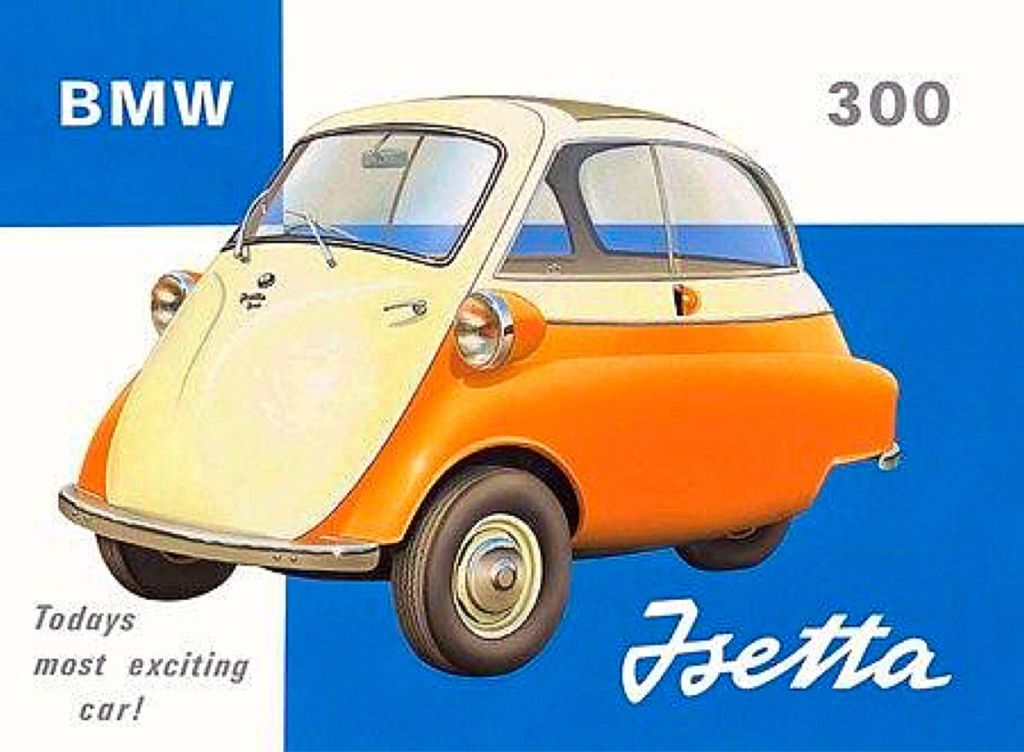
The BMW Isetta is a microcar that was produced by BMW from 1955 to 1962. It is perhaps best known for its distinctive front-opening door, which also served as the car’s only door. The Isetta was designed by the Italian firm Iso SpA and was originally produced by them in Italy under the name “Iso Isetta”. BMW acquired the license to produce the car and made several modifications to the design before beginning production in 1955.
The Isetta was powered by a single-cylinder, four-stroke engine with a displacement of 247 cc or 298 cc, depending on the model. It was capable of achieving a top speed of around 53 mph (85 km/h) and had a fuel consumption of around 60 mpg (25.5 km/L).
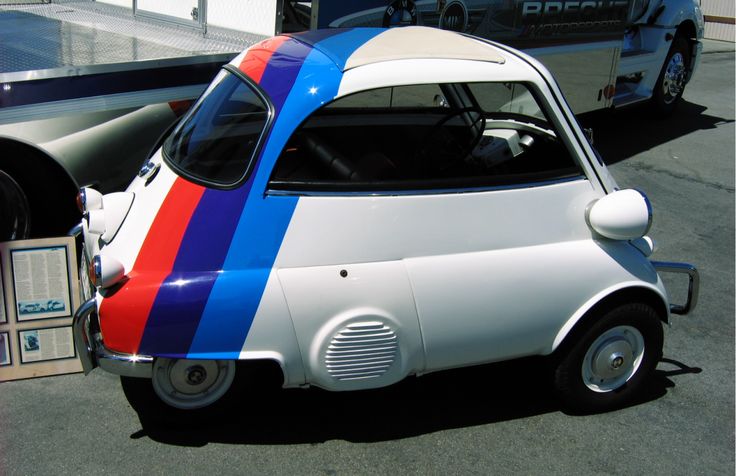
The Isetta was a popular car in Europe during the 1950s and early 1960s, and it was also sold in the United States. It was marketed as a practical and economical car for urban use, and its small size made it ideal for navigating narrow European streets and fitting into tight parking spaces.
Today, the Isetta is considered a classic car and is popular among collectors. Its unique design and historical significance make it a sought-after vehicle for car enthusiasts and collectors around the world.
If you are interested you should read about the Best Classic cars ever made
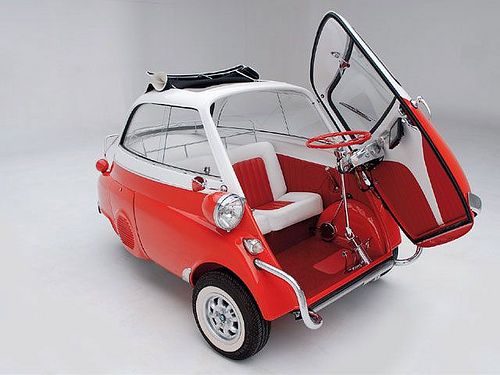
BMW Isetta interior
The interior of the BMW Isetta is quite minimalist, due to the car’s small size and simple design. The car’s front-opening door is also its main entrance and exit point, and it swings out with the steering column attached to it for easy access. Once inside, the driver and passenger sit on a bench seat that is positioned very close to the front of the car.
The dashboard of the Isetta is also quite basic, featuring a speedometer, fuel gauge, and a few simple controls for the lights and wipers. There is no radio or air conditioning, as these features were not common in cars of this size and era.
The Isetta’s small size and lack of amenities make it a very compact and efficient vehicle, but also means that it may not be as comfortable or convenient to use as larger, more modern cars. Nonetheless, the Isetta’s unique design and historical significance continue to make it a beloved classic car among enthusiasts.
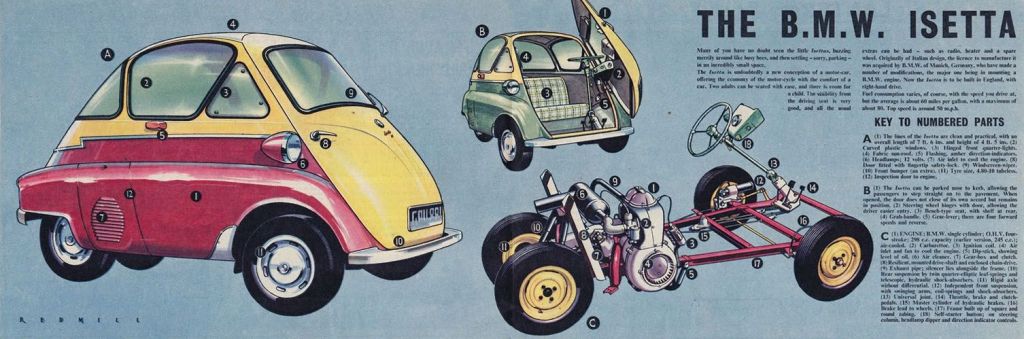
BMW Isetta engine
The BMW Isetta was powered by a single-cylinder, four-stroke engine located at the rear of the car. The engine was available in two sizes: a 247 cc engine that produced 9 horsepower, and a 298 cc engine that produced 13 horsepower. The engine was air-cooled and featured a single carburetor, as well as a simple fan system for cooling.
The engine was mounted directly to the rear axle, which helped to simplify the car’s design and reduce its weight. The transmission was a four-speed manual gearbox that was located directly behind the engine, and it was operated by a column-mounted shifter.
Despite its small size and low power output, the Isetta’s engine was able to propel the car to a top speed of around 53 mph (85 km/h), which was quite impressive for a car of its size and era. The car’s efficient design also allowed it to achieve a fuel economy of around 60 mpg (25.5 km/L), making it an economical choice for urban drivers.
The Isetta’s simple, reliable engine contributed to the car’s popularity and helped to establish it as an icon of mid-century automotive design.

Follow us on instagram
 Car Community
Leave a comment