

The year is 1939. Europe stands on the brink of war, yet automotive innovation continues behind the scenes. In a small German workshop, Professor Ferdinand Porsche and his team quietly develop what would become the foundational blueprint for one of the world’s most celebrated sports car manufacturers.
The Porsche 64, also known as the Type 64 and Type 60K10, represents not just a vehicle but the tangible manifestation of a dream that would eventually transform the automotive landscape.
Commissioned by Volkswagen as a competition vehicle, the Type 64 was conceived for the 1939 Berlin-Rome race, a planned 940-mile endurance event intended to showcase Germany’s autobahn network and automotive prowess. Though the race never occurred due to the outbreak of World War II, the three prototype cars built for this event would establish the design language and engineering philosophy that define Porsche to this day.
The Type 64’s creation stemmed from Ferdinand Porsche’s persistent vision for a sports car based on Volkswagen components. Despite his work on the “people’s car” (later known as the Volkswagen Beetle), Porsche never abandoned his passion for high-performance vehicles. The Type 64 became the perfect fusion of these two worlds, combining accessible mechanical components with advanced aerodynamics and lightweight construction that hinted at the sports car dynasty to come.
Porsche 64 Design
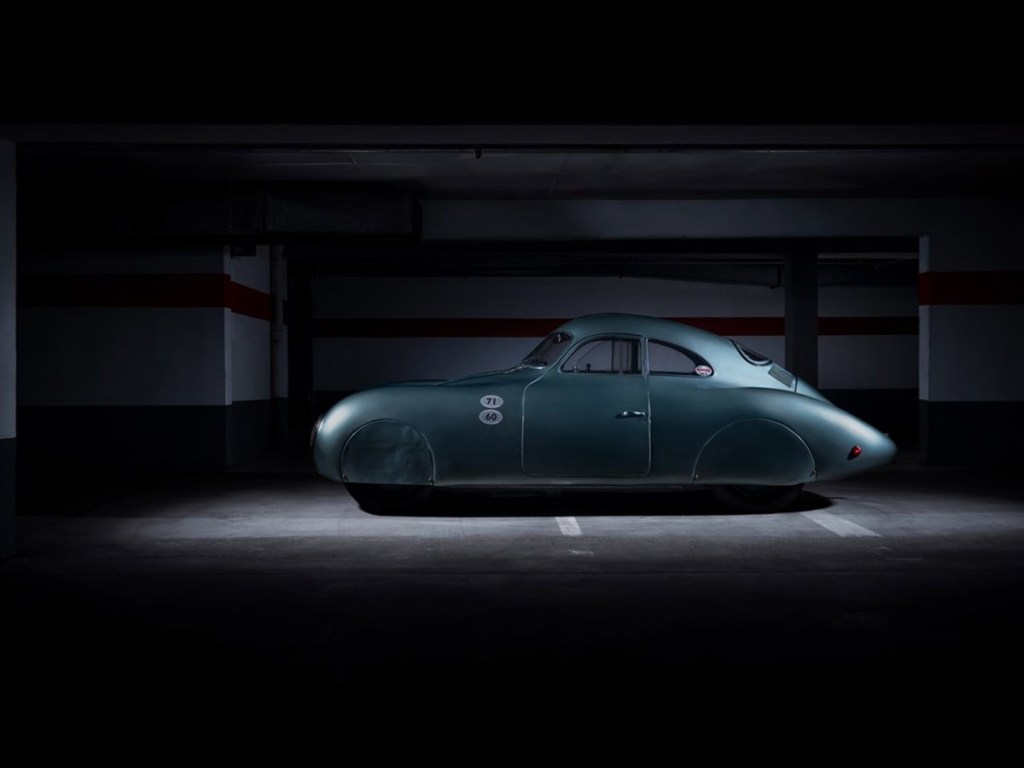
The Porsche 64 represented a quantum leap in automotive design, incorporating aircraft-inspired construction techniques that were revolutionary for the late 1930s. Unlike standard production vehicles of the era, the Type 64 featured a hand-formed aluminum body attached with over 2,000 rivets, a construction method more commonly found in aircraft manufacturing than automotive design.
Beneath its sleek exterior, the Type 64 utilized a modified Volkswagen platform with significant enhancements. The chassis featured a steel-pressed backbone flanked by rectangular tubular frames crafted from aircraft-grade duralumin, to which alloy floor pans and underbody components were welded. This advanced construction method resulted in an incredibly lightweight vehicle weighing just 1,350 pounds, approximately 400 pounds lighter than the standard Volkswagen Beetle of the era.
The aerodynamic body design was particularly revolutionary, featuring a streamlined shape that achieved a drag coefficient of just 0.385, remarkably low even by modern standards. The bodywork incorporated faired-in headlights, covered rear wheel arches, and a tapered tail section that all contributed to its exceptional aerodynamic efficiency.
Porsche Type 64 Specifications
| Component | Specification |
|---|---|
| Engine | 1.0L flat-four (modified Volkswagen) |
| Power Output | 32-40 horsepower |
| Top Speed | 93-99 mph |
| Weight | 1,350 pounds |
| Chassis | Steel backbone with aluminum framework |
The engine, based on the Volkswagen air-cooled flat-four, was substantially modified with higher compression ratios, larger valves, and dual carburetors that increased power output from the standard 23.5 horsepower to between 32 and 40 horsepower. This power increase, combined with the dramatically reduced weight, enabled the Type 64 to achieve top speeds between 93 and 99 mph, extraordinary performance for a car based on “people’s car” components.
Porsche Type 64 Prototypes
Only three Type 64 prototypes were ever built, each with its own remarkable survival story that adds to the vehicle’s legendary status. The first prototype, completed in 1939, served as the development model and demonstration vehicle. The second car was intended for competition use, while the third served as the personal transport for the Porsche family.
The first prototype was reportedly destroyed during World War II, though some accounts suggest it may have been dismantled for parts. The second prototype suffered damage during the war but was rebuilt using components from the first car. This vehicle eventually became part of the Porsche family’s personal collection and remains the best-preserved example.
The third chassis, completed in 1940, became Ferry Porsche’s personal car and served as daily transportation for the Porsche family in the difficult postwar years. This vehicle survives today as the most original example and represents the direct link between the Type 64 and the subsequent Porsche 356.
These cars survived bombings, postwar austerity, and numerous ownership transitions to become among the most valuable and historically significant automobiles in existence. Their preservation represents a miracle of automotive history, saving for posterity the physical evidence of Porsche’s origins.

Porsche Type 64 Racing
Though the Berlin-Rome race for which the Type 64 was designed never occurred, the vehicle did see limited competition use that demonstrated its impressive capabilities. In 1940, the Porsche team entered a Type 64 in a race from Berlin to Rome that was reconceived as a reliability trial rather than a speed competition.
The car performed flawlessly in this event, covering the distance with exceptional efficiency and reliability. This performance validated Ferdinand Porsche’s design philosophy and provided crucial data that would inform the development of future Porsche sports cars.
After the war, the surviving Type 64 prototypes participated in various alpine rallies and local racing events, often driven by members of the Porsche family or company engineers. These outings served as mobile test sessions, allowing the development team to refine concepts that would appear in production Porsches.
Porsche 64 Through the History
The Porsche Type 64 represents the crucial evolutionary link between the Volkswagen Beetle and the Porsche 356. Every design element that would become synonymous with Porsche sports cars can be traced back to this pioneering vehicle.
The rear-engine layout, air-cooled flat-four engine, aerodynamic body shape, and even the basic operational concept of a lightweight sports car based on reliable mechanical components all found their first expression in the Type 64. When Ferry Porsche decided to build his own sports car in 1947, he didn’t start from scratch, he used the Type 64 as both inspiration and technical foundation.
Frequently Asked Questions
Why is the Porsche 64 sometimes called the Type 64?
The designation “Type 64” follows Porsche’s internal numbering system from that era. The Volkswagen Beetle was designated Type 60, and the sports car derivative based on its components became Type 64. The “64” refers to the project number within Porsche’s development system.
How many Porsche 64 cars were built?
Only three complete Porsche 64 cars were built between 1939 and 1940. The first was completed in 1939, with two additional examples finished in 1940. Just two of these original vehicles survive today.
What is the relationship between the Porsche 64 and Volkswagen Beetle?
The Porsche 64 was based directly on Volkswagen Beetle components, using the same basic chassis layout, suspension design, and air-cooled flat-four engine architecture. However, the Type 64 featured extensive modifications including increased engine power, lightweight construction, and advanced aerodynamics.
Why isn’t the Porsche 64 considered the first Porsche production car?
While the Type 64 was the first car to bear the Porsche design philosophy, it remained a prototype rather than a production vehicle. The Porsche 356, introduced in 1948, was the first Porsche model offered for sale to the public and is therefore considered the first production Porsche.
What happened to the surviving Porsche 64 cars?
One surviving Type 64 remains in the possession of the Porsche family and is occasionally displayed at museum events. The other known survivor is in private ownership and has appeared at major automotive concours events. A third car was reportedly dismantled for parts after suffering damage during World War II.
How much is a Porsche 64 worth today?
As one of the most significant automobiles in history, the Porsche 64 is essentially priceless. The few existing examples are rarely offered for sale, but similar historically significant prewar racing prototypes have sold for tens of millions of dollars at auction.
Did the Porsche 64 influence later Porsche models?
Absolutely. The Type 64 directly influenced the design of the Porsche 356, which shared its basic layout, engineering philosophy, and even visual styling cues. The concept of a lightweight, aerodynamic sports car based on reliable Volkswagen components established the template for Porsche’s early success.

 Car Community
Leave a reply to HAUATA Cancel reply