

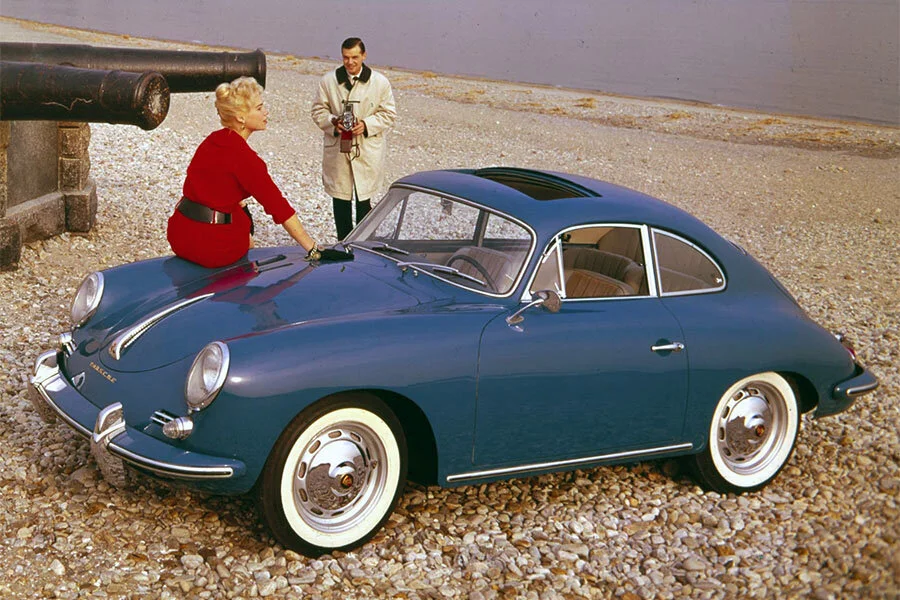
In the aftermath of World War II, as Europe lay in ruins, an automotive revolution was quietly taking shape in a converted sawmill in the Austrian Alps. Here, a small team led by Ferry Porsche began work on a car that would defy the limitations of its time.
The Porsche 356 emerged not merely as a vehicle, but as a statement of resilience, a lightweight, rear-engine coupe that blended elegance with efficiency and performance with practicality. It became the foundational blueprint for what would evolve into one of the world’s most revered automotive brands. This is the story of the car that started it all.
The Birth of Porsche 356
The genesis of the Porsche 356 traces back to 1948, when Ferry Porsche famously declared that he couldn’t find the sports car of his dreams, so he decided to build it himself. Utilizing components from the Volkswagen Beetle, designed by his father Ferdinand Porsche, the first prototype known as 356/1 was built in Gmünd, Austria. This hand-built aluminum roadster featured a mid-engine layout and served as the proof of concept for what was to come.
Production officially began with the 356/2, which moved the engine to the rear to accommodate two rear seats, establishing the layout that would become synonymous with Porsche for decades. Only 50 aluminum-bodied cars were produced in Austria before manufacturing shifted to Zuffenhausen, Germany, in 1950, where steel bodies manufactured by Reutter replaced aluminum.
The early years were characterized by continuous improvement. What began as a modest 40 horsepower engine would eventually evolve through numerous iterations, each enhancing performance, handling, and comfort while maintaining the distinctive silhouette that made the 356 immediately recognizable.

Porsche 356 Design
The Porsche 356 represented a masterpiece of efficient design. Erwin Komenda’s aerodynamic body achieved a drag coefficient of just 0.36, remarkably low for its time and contributing significantly to both performance and fuel efficiency. The car’s lightweight construction, approximately 1,400 pounds for the earliest aluminum models, meant that even modest power outputs could deliver spirited performance.
Throughout its lifespan, the 356 evolved through four distinct generations, each bringing refinements while maintaining the car’s essential character. The Pre-A models (1948-1955) featured split windshields and increasingly powerful engines. The 356 A (1955-1959) introduced a curved windshield and the legendary Carrera engine. The 356 B (1959-1963) brought raised bumpers and improved ergonomics, while the final 356 C (1963-1965) added four-wheel disc brakes as standard equipment.
Porsche 356 in Motorsport
Before the 911 dominated racetracks worldwide, the 356 established Porsche’s competition pedigree. The lightweight construction and agile handling made it a natural contender in endurance events and rally competitions. In 1951, a modified 356 scored Porsche’s first class win at the 24 Hours of Le Mans, beginning a tradition of motorsport excellence that would become central to the brand’s identity.
The racing variants, particularly the 356 Speedster, became favorites among amateur racers on both sides of the Atlantic. Its success in production-based racing categories demonstrated the durability and performance potential of Porsche’s engineering philosophy. The lessons learned from competition directly influenced the development of subsequent road cars, establishing the “win on Sunday, sell on Monday” approach that would serve Porsche for decades.
Porsche 356 Impact on Transportation
The Porsche 356 transcended its role as mere transportation to become a cultural icon. Its appearance in films, television shows, and celebrity garages cemented its status as a symbol of style and sophistication. James Dean owned a 356 Speedster before his fatal crash in his Porsche 550 Spyder. Steve McQueen purchased a 356 as his first new car and won his first race with it. Sean Connery drove a 356 during his early career, and even Janis Joplin famously celebrated her 356 in song.
The car’s design influenced automotive aesthetics for generations, with its clean lines and functional beauty representing the ideal of form following function. The distinctive shape became instantly recognizable, appearing in advertisements, artwork, and popular media as a symbol of European style and engineering excellence.

Porsche 356 Evolution
The Porsche 356 was produced in numerous variants throughout its production run, each catering to different markets and preferences. The coupe remained the most popular body style, but the convertible models, particularly the Speedster, developed a strong following, especially in the United States.
The Speedster originated when American importer Max Hoffman suggested a lower-cost, stripped-down model for the competitive American market. The resulting car featured a lower windshield, simplified top, and minimal weather protection, creating an affordable and focused driving experience that became immensely popular.
At the opposite end of the spectrum, the Carrera models featured sophisticated four-cam engines derived from Porsche’s racing program. These high-performance variants could achieve top speeds approaching 125 mph, remarkable for a production car of the era.
Porsche 356 Value Appreciation
Today, the Porsche 356 enjoys legendary status among collectors and enthusiasts. Values have appreciated significantly, with exceptional examples commanding prices well into the hundreds of thousands of dollars. The earliest aluminum-bodied Gmünd models are particularly prized, as are the racing-derived Carrera variants and the open-top Speedsters.
The market recognizes several factors that influence value, including originality, documentation, and provenance. Cars with known history, particularly those with celebrity ownership or competition history, command substantial premiums. Despite the rising values, the 356 remains a practical classic, with extensive support from specialist workshops and a plentiful supply of reproduction parts.
Restoration requires specialized knowledge, particularly for the earliest models, but the mechanical simplicity compared to modern vehicles makes the 356 accessible to enthusiasts with moderate technical skills. Many owners drive their cars regularly, participating in rallies and events worldwide.

Frequently Asked Questions
What was the first Porsche model ever produced?
The Porsche 356 was the first production automobile from Porsche, with the initial prototype completed in 1948 and production beginning in earnest in 1950.
How many Porsche 356 models were produced?
Approximately 76,000 356 models were built between 1948 and 1965, including all variants and body styles.
What different body styles were available?
The 356 was offered as a coupe, cabriolet (convertible), roadster, and speedster. The speedster was the most minimalist version, designed for racing and sunny weather driving.
What is the difference between the various 356 generations?
The Pre-A models (1948-1955) had split windshields and less powerful engines. The 356 A (1955-1959) featured a curved windshield and more power. The 356 B (1959-1963) had raised bumpers and interior improvements. The 356 C (1963-1965) included disc brakes and the most powerful production engines.
Why is the 356 Speedster so desirable?
The Speedster’s minimalist design, light weight, and racing pedigree make it highly sought after. Its association with California car culture and celebrity owners has enhanced its desirability.
How does the 356 compare to the later Porsche 911?
The 356 established the rear-engine layout and design language that the 911 would develop further. The 911 was larger, more powerful, and more refined, but maintained the same fundamental philosophy established by the 356.
What should potential buyers look for when considering a 356?
Rust is the primary concern, particularly in the floor pans, battery boxes, and door sills. Mechanical parts are generally available, but body repair requires specialized skills. Documentation and originality significantly affect value.
Leave a Reply to The History of Porsche – Car CommunityCancel reply